The more information converges in towers, remote towers and control centres, the more important the controller working position itself becomes. Radar data, flight plan data, weather information, communications systems, camera feeds and technical monitoring data must not only be available. They need to be consolidated, displayed and made accessible in a way that allows ATCOs and technical teams to use them quickly and safely, without being slowed down by system complexity.
At the same time, air traffic control is subject to strict operational and technical requirements. Systems must be available, reliable and protected. Redundancy, access control, stable signal transmission and cybersecurity are not add-ons, but part of the overall safety and security concept.
This is where the real task of modern controller working positions begins: they need to make complexity visible without passing it on to the user. Usability and safety should therefore not be planned separately. They need to work together across the infrastructure, workplace design and system access.
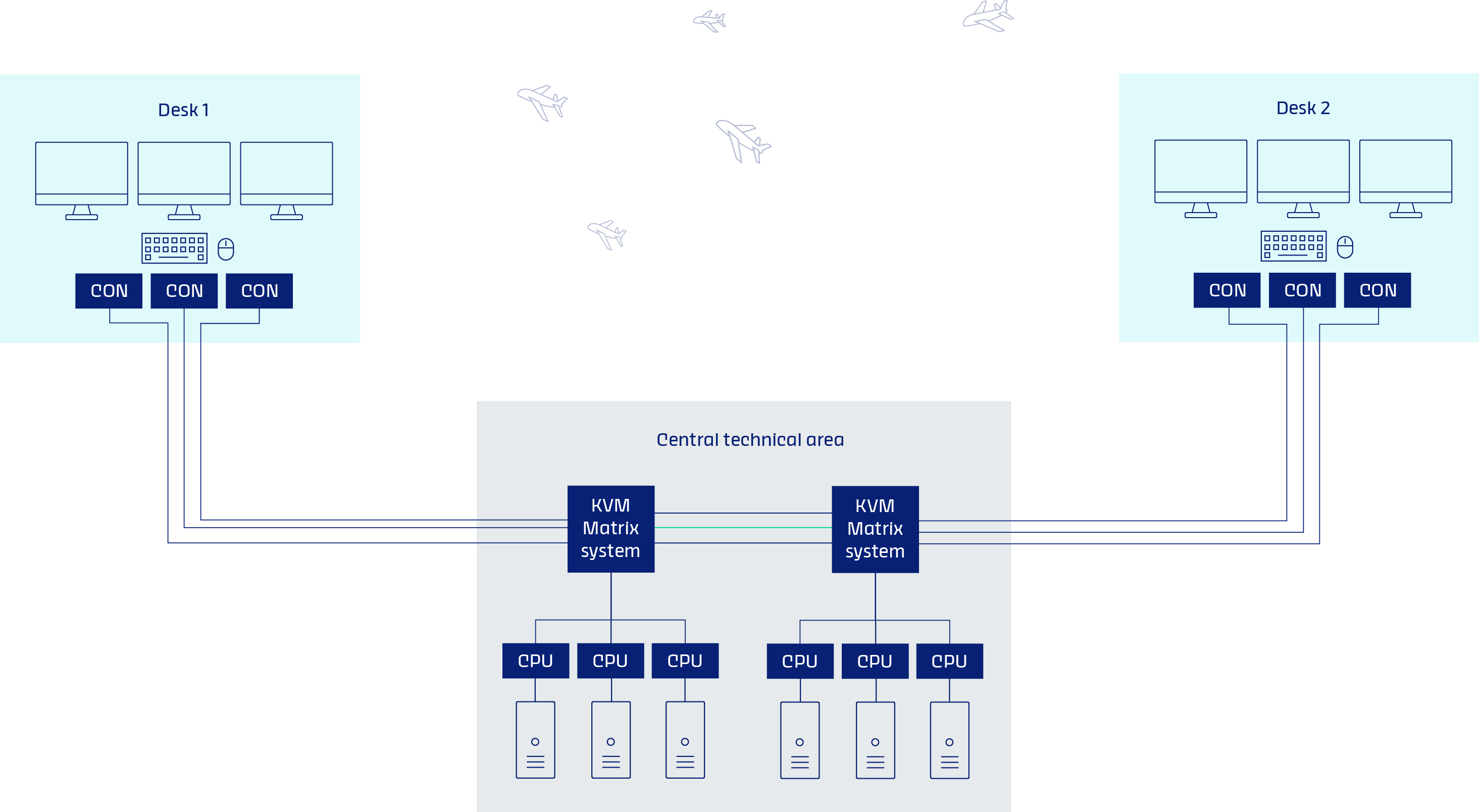
KVM technology can help bring these requirements together. In towers, remote towers and control centres, it enables flexible access to IT systems, supports clearer workplace concepts and can contribute to the reliable availability of critical systems through redundantly designed components and signal paths.
Why controller working positions need to support more today
The demands placed on controller working positions are increasing because the technical environment is changing. Digital tower concepts, networked systems, additional data sources and higher cybersecurity requirements mean that information does not only need to be available. It also needs to be displayed meaningfully, accessed securely and operated reliably.
For ATCOs, this means the workplace must create overview. Relevant information should be available where it is needed. Switching between systems, monitors or input devices should be reduced as much as possible. The more complex the environment becomes, the more important clear, ergonomic and consistent operation becomes.
Technical teams also benefit from an infrastructure that makes systems centrally accessible while providing clear control and security mechanisms. Especially in control rooms, technical operations rooms or remote tower environments, flexible access to different computers and sources can simplify workflows.
Making information diversity easier to manage
In modern air traffic control rooms, it is not just about displaying large amounts of information. What matters is how this information can be arranged, combined and operated. If every source requires its own monitor or separate input device, the workplace can quickly become cluttered and difficult to manage.
Multi-viewing solutions make it possible to display multiple sources flexibly on one large display or across several monitors. Work and monitoring areas can be arranged individually. Once configured, arrangements can be saved as presets and recalled when needed. This supports flexible workplace concepts, for example for different tasks, roles or operational situations.
For ATCOs, this can mean less visual fragmentation, faster access to relevant sources and a workplace environment that can be adapted more effectively to specific situations.
Digital towers: clarity instead of information overload
This development is particularly visible in digital towers. Here, camera systems, video walls and digital information sources replace or complement the direct out-the-window view from the tower. This creates new possibilities, but also new requirements for display and operation.
Weather data, flight plan data, radar information and camera feeds need to be brought together in a way that provides orientation rather than overload. For ATCOs, it is not the sheer amount of information that matters, but how usable it is at the right moment.
KVM and multi-viewing solutions can help provide different sources in a structured way. Depending on the application, panoramic images, individual video sources and supplementary data can be displayed and operated within a shared working environment. This makes the workplace a central element of the digital tower concept.
Security starts with the infrastructure
Alongside usability, security is the second key aspect. In air traffic control, systems not only need to be operated efficiently; they also need to be reliably protected. This applies to physical security, cybersecurity and operational resilience.
KVM technology allows computers to be housed in secure technical areas, while ATCOs and technical teams access the required systems from their workplace. This spatial separation can help protect sensitive systems more effectively and create a more controlled infrastructure setup.
Redundancy also plays an important role. If a primary system fails, an alternative system must be available quickly and reliably. Redundantly designed KVM infrastructures, for example with two KVM matrices or separate signal paths, can help secure access to critical systems even in the event of disruptions.
From a cybersecurity perspective, it is relevant that KVM provides access to computers via defined interfaces such as video, keyboard and mouse, without creating a direct logical connection between the connected computer systems. This allows sensitive systems to remain in protected technical areas while being accessed from the workplace in a controlled manner. Additional security features such as encryption, user rights and two-factor authentication further strengthen protection.
Flexible workplace solutions for an optimized user experience
In this context, G&D offers various solutions that support ATCOs in terms of display, access and operation.
With the DynamicWorkplace-CON, KVM matrix installations can be extended with flexible multi-viewing functions. The product enables up to eight computer sources to be displayed and operated in real time across up to four monitors. Using the integrated window manager, sources can be positioned freely and adapted to individual work or monitoring areas. Support for resolutions of up to 4K at 60 Hz contributes to a clear and ergonomic display at the controller working position.
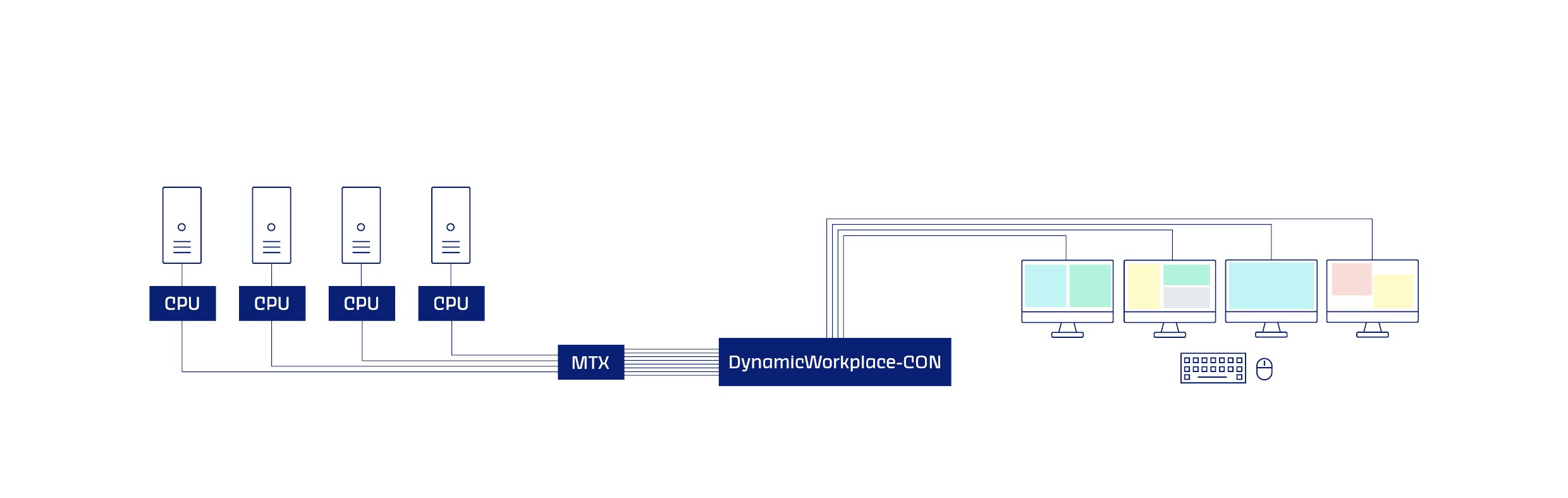
The PersonalWorkplace-Controller combines multi-viewing with keyboard/mouse interaction and supports flexible access to physical sources and streams. This is particularly relevant for control rooms, technical operations rooms or video wall environments where content needs to be displayed and operated according to the situation.
In addition, CommandKeyboard-Advanced brings central operating and control functions directly to the workplace. With haptic inputs, an integrated touch display, illumination and its own processing power, control interfaces, HTML5 dashboards or predefined inputs can be used directly on the device. Especially in high-security environments, it is relevant that predefined inputs can be triggered without the keyboard itself requiring a network connection.
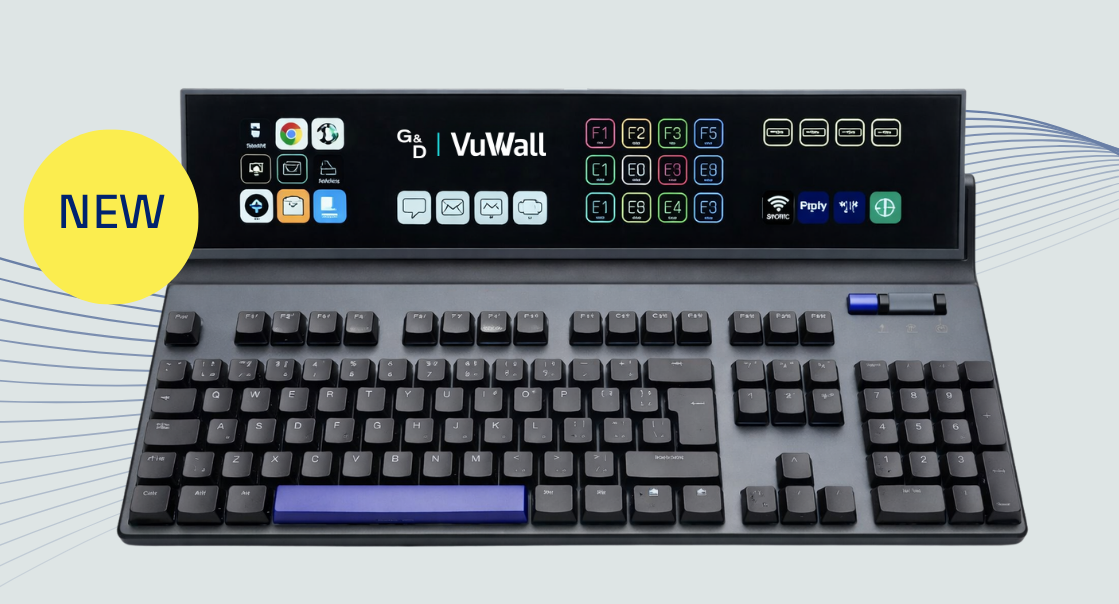
Together, these solutions show how modern workplaces in air traffic control can do more than provide access to systems. They can also bring display, operation and security together more effectively.
Conclusion
Controller working positions have a clear task: they need to make growing volumes of information, more complex system landscapes and higher security requirements manageable. It is not enough to make individual systems more powerful. What matters is how information becomes accessible, visible and operable.
KVM and multi-viewing technologies, together with smart operating concepts, can play an important role here. They support flexible system access, structured information display, spatial separation of users and technology, as well as redundancy and security concepts.
At the G&D booth H2-B29 at Airspace World, visitors and technical teams from ANSPs can experience what control rooms can look like in practice: clear, flexible, redundant and secure. The focus is on solutions that help make complex ATC environments easier to manage.
>> Other articles you might be interested in:
bluedec™ – Our Video Compression for Control Rooms, Now Even More Powerful
Trusted. Improved. VisionXS 2.0
Sie finden mich auch auf LinkedIn.
Marketing Communications Manager at Guntermann & Drunck.
You can find me on LinkedIn.
- Vutec (Pty) Ltd Appointed as the Exclusive Distributor for G&D and VuWall Solutions in South Africa - 19. June 2026
- The new CommandKeyboard-Advanced: G&D and VuWall Launch Operator Control Unit That Runs Without a Network Connection - 11. June 2026
- VuWall and G&D to Showcase Unified Control Room Technology at InfoComm 2026 - 21. May 2026