
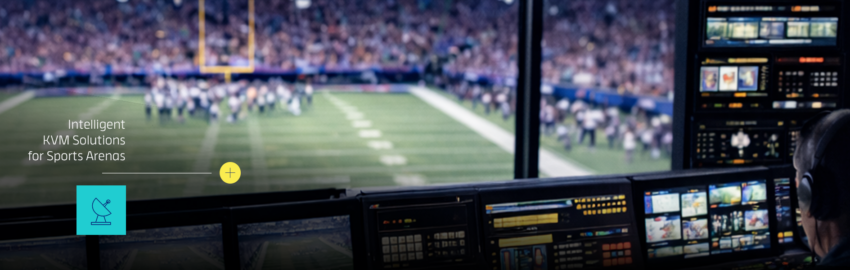
Modern sports arenas rely on distributed, real-time systems that must perform reliably during live events. From broadcast production to replay, security, and venue operations, technical teams depend on predictable performance and immediate system response. This blog post outlines the key operational challenges in modern sports arenas and explains how KVM technology supports stable, secure, and high-performance operations in live environments.
On game day, sports arenas operate under intense operational pressure. Live broadcast production, replay and review systems, LED displays, security monitoring, and venue operations all run in parallel, in real time, without tolerance for delay or instability.
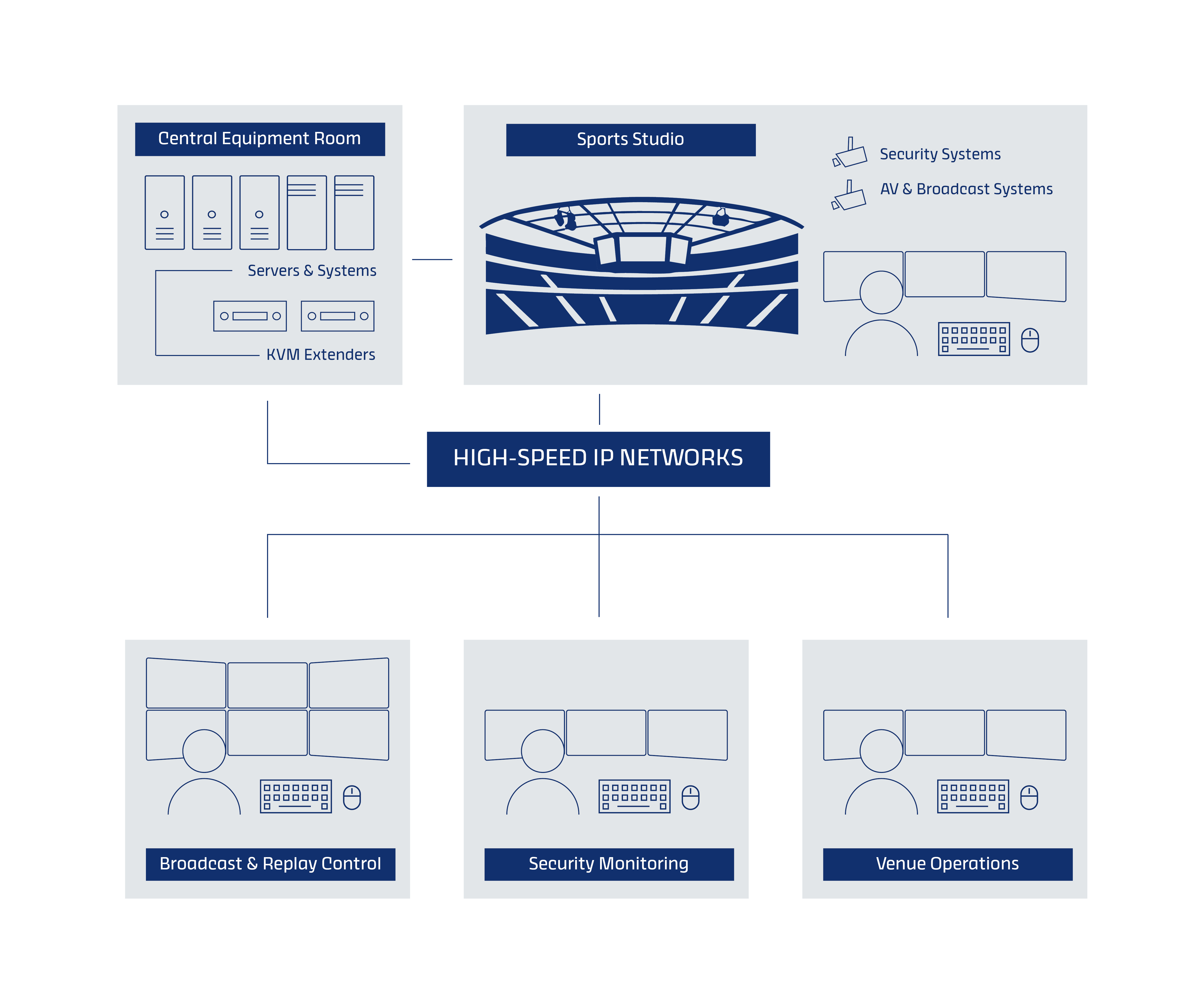
Behind the scenes, this requires reliable control of many computers and systems. These systems are centralized in secure equipment rooms, distributed across technical floors, or accessed remotely as part of the overall infrastructure design. KVM systems provide an access layer that allows operators to interact with these distributed systems in real time, independent of physical distance and without compromising performance. IP-based architecture enables maximum flexibility in distance, scalability, and system expansion across the venue.
Modern Arena Operations
Today’s sports arenas are converged IP environments, where broadcast, AV, IT, and security systems operate on shared backbones with logical separation and performance controls.
As arenas grow in size and complexity, technical teams face a set of recurring operational challenges:
- Multi-floor and multi-location access: Operators must reliably control systems that are physically distributed across multiple floors, buildings, or centralized equipment rooms.
- Workspace efficiency: High system density at operator desks leads to increased heat, noise, and clutter, directly affecting operator comfort and long-term reliability.
- Flexible workflows: Broadcast, security, and venue operations teams need to monitor and control multiple systems simultaneously, often across multi-monitor workstations.
- Latency-sensitive workflows: Live production, replay, and review require immediate system response.
- Event-driven reconfiguration: Infrastructure must support frequent transitions between sports events, concerts, and special productions.
- Security and access control: Internal feeds and operational systems must be protected during high-visibility events.
KVM supports these requirements by enabling consistent, real-time access to distributed systems while allowing infrastructure and workspace design to scale independently.
Operational Resilience for Live Events
In a live sports environment, performance alone is not enough. Systems must continue operating even when individual components fail. Our systems address this requirement with built-in redundancy concepts designed specifically for real-time KVM environments.
Central to this approach is the DirectRedundancyShield (DRS) for KVM-over-IP matrices.
DRS enables two central KVM matrix systems to operate in an active/standby configuration. Operator and computer modules maintain parallel connections to both systems. If the active matrix system becomes unavailable, the system switches automatically to the standby matrix system within a fraction of a second, without requiring operator intervention.
From the operator’s perspective, ongoing sessions and switching states remain intact. Video signals stay stable, input control continues seamlessly, and workflows are preserved even during failure. For latency-critical applications such as live replay, broadcast production, or officiating review, this ensures uninterrupted operation at the exact moment reliability matters most.
Combined with redundant power supplies, network paths, and optional transmission redundancy at the endpoint level, this approach delivers a KVM infrastructure designed not only for performance, but for operational continuity under live-event conditions.
Why Arena Teams Should Choose G&D
Our KVM solutions are designed for environments where responsiveness, signal integrity, and operational stability matter.
Ultra Low-Latency Control for Live Operations
Near-zero latency ensures that operator inputs such as camera control, replay triggering, and graphics switching are reflected immediately on the controlled systems, even during controller failover scenarios in redundant KVM architectures. This is essential for real-time decision-making during live events.
Pixel-Perfect Video for Production and Review
Our systems support uncompressed video as well as compressed transmission options, while maintaining pixel-accurate image reproduction. Broadcast engineers, replay operators, and game officials see exactly what the source systems output on their operator monitors.
Intuitive Multi-System Operation
With smart operating features in our KVM solutions, such as CrossDisplay-Switching and Scenario Switching, operators can work efficiently across complex setups. CrossDisplay-Switching automatically assigns keyboard and mouse control to the system displayed on a monitor, simply by moving the cursor to that screen. Scenario Switching allows predefined workstation configurations to be recalled instantly. This eliminates manual reconfiguration, reduces operator error, and supports fast, confident operation under pressure.
Secure Operation in High-Profile Environments
Encrypted connections, user-based access control, and network segmentation help protect internal feeds and control systems, supporting secure operations during major live events.
Optimized Control Rooms
By centralizing servers and workstations, arenas reduce heat, noise, and hardware density at operator desks. This improves operator focus, simplifies maintenance, and increases long-term system reliability.
Designed to Scale with the Venue
As arenas evolve and expand, the KVM-over-IP system can be expanded at any time to support additional workstations and systems. New operator positions are integrated without impacting existing workflows or live operations.
For decision-makers, this means investment protection and long-term flexibility. For engineering teams, it means predictable, real-time performance when it matters most.
Conclusion
In live sports arenas, success on game day depends on predictable system behavior under changing conditions. Operators must access distributed systems reliably, workflows must remain responsive under load, and infrastructure must adapt quickly as events and requirements change, all without compromising security or operator efficiency.
Our KVM solutions are designed for these realities. They enable stable, low-latency operation across distributed environments and incorporate resilience mechanisms that allow live operations to continue seamlessly even in the event of system failure.

- G&D and VuWall Unveil vsNEO, a Zero-Config KVM Platform Built for Simpler Control Room Deployment - 11. September 2026
- More Data, Better Decisions? How To Avoid Information Overload in Control Rooms - 11. August 2026
- Vutec (Pty) Ltd Appointed as the Exclusive Distributor for G&D and VuWall Solutions in South Africa - 19. June 2026