
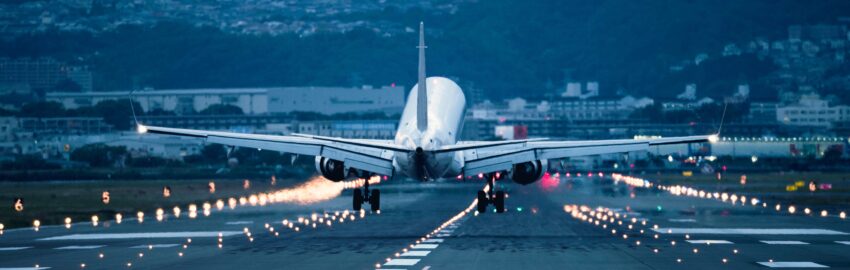
Air traffic control is undergoing a major modernization. In the United States, the Federal Aviation Administration (FAA) is upgrading key components of its communications, surveillance, and automation infrastructure through the “Brand New Air Traffic Control System” (BNATCS) initiative. In Europe, air navigation service providers and organizations such as EUROCONTROL are also advancing their Air Traffic Management (ATM) and Communication, Navigation and Surveillance (CNS) infrastructure.
The programs differ significantly in scope and technical implementation. What they have in common, however, is that new systems cannot operate in isolation. They must be integrated into existing operational models, technical architectures, and processes while remaining reliable, available, and maintainable for decades to come.
Europe can draw on decades of operational experience in this area. Germany, too, has a long history of developing and continuously improving highly available air traffic control infrastructure. While these lessons cannot be applied directly to new modernization programs, they highlight the questions that matter in real-world operations: Where do dependencies arise? Which systems require alternative access paths? How can system health and status be monitored? And how can infrastructure be maintained and upgraded without unnecessarily disrupting controllers’ working environments?
Many of these challenges are familiar to us from our own projects in air traffic control towers, control centers, simulation environments, and remote towers. In these settings, our KVM systems form part of a broader technical architecture, connecting controllers’ workstations to the computer systems they rely on in their daily operations.
Budapest: Redundancy at Multiple Levels
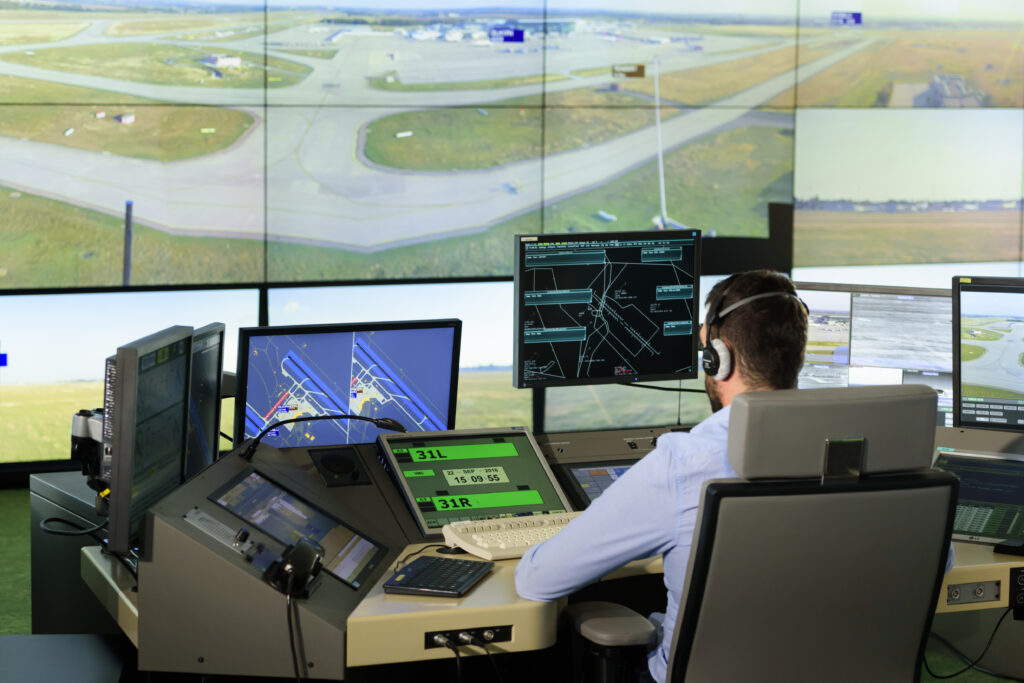
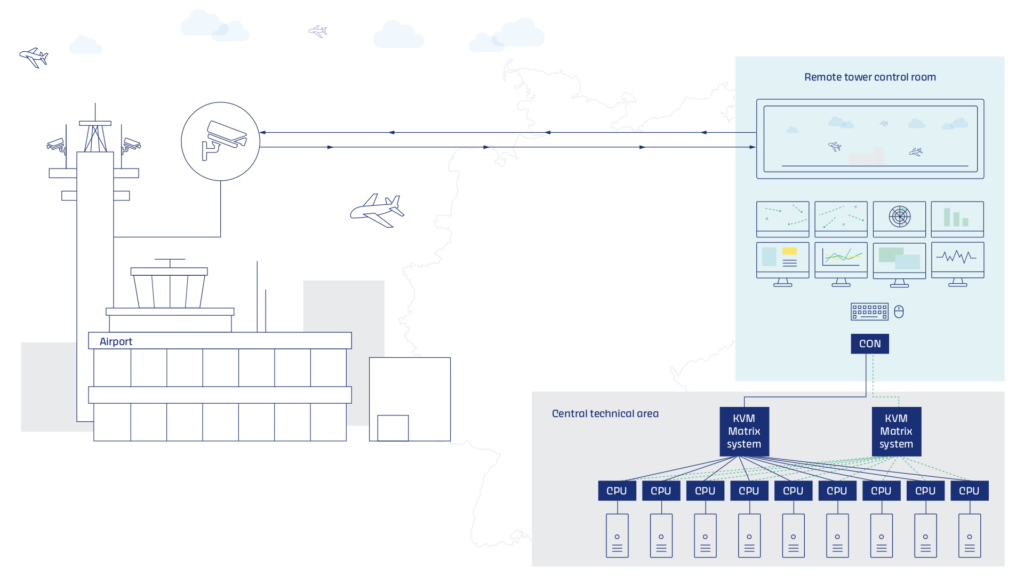
HungaroControl’s remote tower project in Budapest illustrates how resilience can be built into different layers of a technical architecture. The operational environment combines an existing ground surveillance system with a network of cameras at the airport. Four video wall servers provide the imagery for a 32-display video wall. In the control room, five Controller Working Positions (CWPs) each provide access to multiple computers. Some of these computers are housed in a climate-controlled, access-secured server room and made accessible from the workstations via our ControlCenter-Digital matrix.
Redundancy is implemented at multiple levels. In addition to the video wall servers and operator computers, the KVM infrastructure itself is designed for redundancy. A second, fully mirrored ControlCenter-Digital matrix can automatically take over if the primary matrix fails. The operational status of the KVM components is also monitored via SNMP.
What makes this setup particularly noteworthy is its architecture. Computing resources, video infrastructure, KVM access, redundancy, and monitoring all work together as part of an integrated system. At the same time, the computers housed in a separate location can be maintained and configured without directly interfering with the ATCOs’ working environment.
Braunschweig: KVM as Part of a New Operational Model
The remote tower project in Braunschweig highlights a different aspect of resilient infrastructure. DFS Aviation Services planned a centralized facility that would initially provide air traffic control services for Braunschweig-Wolfsburg and Emden airports. The technical feasibility of the concept was evaluated in collaboration with the German Aerospace Center (DLR). Our KVM systems form part of this infrastructure, allowing the required computer systems to be located outside the immediate control environment while still enabling operators to access and control them in real time from their workstations.
The project demonstrates the role that KVM access infrastructure can play in new remote tower operating models: Computing resources and operator workstations no longer need to be located in the same place. As a result, considerations such as system access, availability, maintainability, and potential redundancy become integral to the technical architecture from the outset.
Key Takeaways from These Projects
Budapest and Braunschweig illustrate two different aspects of the same development. While one project focuses on implementing redundancy and safeguards across multiple technical layers, the other demonstrates how a new operational model changes the requirements for accessing computer systems.
What both projects have in common is that KVM is not treated as a standalone system. Instead, the access infrastructure forms part of an interconnected chain extending from the computers through transmission and matrix systems to the operator workstations. Decisions made at one point in this chain can therefore affect other parts of the architecture.
These considerations extend beyond failure scenarios. Monitoring, maintenance, and future modifications also play an important role throughout the lifecycle of an air traffic control infrastructure. When computers are housed in secure technical areas, for example, they can be maintained or replaced independently of the control room itself. Depending on the system architecture, redundant components and alternative access paths can also help minimize disruption to ongoing operations during technical interventions.
This is where Europe’s extensive operational experience offers valuable insights: Resilience is not achieved through a single technical measure. It results from the interplay of system architecture, redundancy, monitoring, operational processes, maintenance, and collaboration between the organizations and technology partners involved.
Our KVM solutions are one component of this broader infrastructure in many of these environments.
What This Means for Modernization Projects
Air traffic control modernization in the United States and Europe is taking place under different conditions. Existing European architectures cannot simply be replicated in new programs. However, lessons learned from decades of operational experience can help identify technical dependencies early in the planning process.
Particularly when introducing new or evolving operational models, it is important to consider access to computer systems from the outset rather than treating it as an afterthought. Computer locations, transmission paths, workstation configurations, monitoring, and potential redundancy are often more closely interconnected than they might initially appear.
For us, this is one of the most important lessons learned from many years of experience in ATC projects: KVM is more than just a connection between workstations and computers. It is an integral part of the technical infrastructure, where availability, maintainability, and reliable system access must work together.
Planning a new ATC infrastructure or modernizing an existing one? Talk to us about your requirements for KVM access, redundancy, and system architecture.
>> Other articles you might be interested in:
More Data, Better Decisions? How To Avoid Information Overload in Control Rooms
Simplifying KVM-over-IP Deployment: G&D and NETGEAR AV Reduce Setup Complexity

- The Future of Air Traffic Control: What It Takes to Build Resilient Infrastructure - 10. November 2026
- G&D and VuWall Unveil vsNEO, a Zero-Config KVM Platform Built for Simpler Control Room Deployment - 11. September 2026
- More Data, Better Decisions? How To Avoid Information Overload in Control Rooms - 11. August 2026