
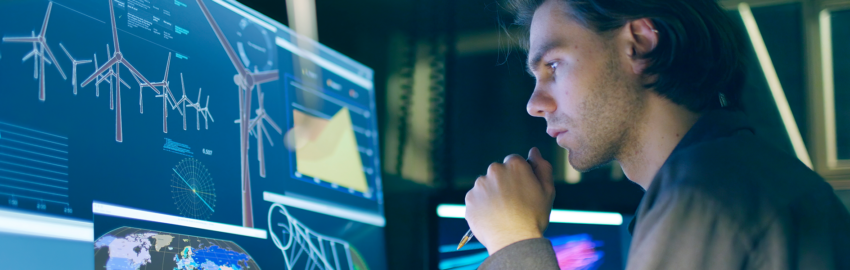
Modern control rooms process more information than ever before: video feeds, sensor and SCADA data, maps, alarms, radio communications, weather updates, and external data sources. This wealth of information can significantly enhance situational awareness, provided that critical information is easy to find, clearly presented, and simple to share across the team. Information overload is not just about the sheer volume of available data. The real challenge lies in quickly identifying what matters, prioritizing it effectively, and seamlessly integrating it into control room operations.
Making Critical Information Instantly Accessible
In many control rooms, operators work across multiple systems, applications, and displays simultaneously. The easier it is to switch between data sources, access relevant information, and coordinate with other workstations, the more effectively available data can be used – especially in time-critical situations.
That’s why control room planning revolves around questions such as:
• What information does an operator need in a specific situation?
• Which data sources should remain visible at all times?
• Which information should only be displayed when needed?
• Who is authorized to view or control a particular source?
• How can relevant views be shared with colleagues or displayed on a video wall?
• How can access remain secure and available, even in the event of a system failure?

Managing information overload therefore becomes a matter of overall control room architecture. Visualization, operator workflows, access management, collaboration, and system resilience all need to work together seamlessly.
Integrating Displays Strategically into the Information Architecture
Control rooms are constantly evolving. New systems are added, additional monitors expand operator workstations, and video walls provide a shared view of the situation. To make the most of these display surfaces, information must be clearly structured and presented in a way that supports the relevant workflow.
The key question is: What information is needed, when, where, and by whom? A well-designed information architecture helps direct attention where it is needed most and ensures that relevant content is easy to access.
A clear distinction between monitoring, analysis, control, collaboration, and escalation is especially helpful. Some information must remain visible at all times, while other content is only needed in specific situations. Certain sources require active interaction, while others are primarily monitored. The roles of workstation displays, the video wall, and the crisis room should also be carefully aligned.
From Source Connectivity to Intelligent Source Management
Reliable access to computers and systems is the technical foundation of any control room. The real value, however, comes from intelligent source management that delivers the right information based on the operator’s task, role, and the current situation.
For example, it defines which operators can access specific systems, which content they can interact with or only view, and which layouts or information should be made available automatically for specific incident scenarios. This provides the foundation for workflow and security features that streamline operations and ensure critical information is available exactly when it is needed.
Integrated Control Room Solutions
The most effective way to manage information overload is to treat source access, operator workflows, collaboration, and visualization as parts of a single, integrated workflow. This is where the solutions and capabilities of G&D and VuWall work seamlessly together.
G&D features such as Scenario Switching, CrossDisplay Switching, and Push-Get enable operators to access the views they need more quickly, switch intuitively between systems, and share relevant content with other workstations or centralized display surfaces.
Solutions such as PersonalWorkplace-Controller, DynamicWorkplace-CON, and CommandKeyboard-Advanced further simplify operations by organizing multiple sources efficiently and providing direct access to frequently used functions.
Centralized visualization management is another key element of this approach. TRx from VuWall provides centralized management of sources, layouts, and display endpoints across the entire control room environment, while ControlVu enables targeted control of content on video walls.
These capabilities are complemented by the security and administration features of G&D’s KVM solutions, including granular access control, Active Directory and LDAP integration, and two-factor authentication.
The result is a unified control room solution that delivers the right information to the right people at the right time, simplifies operator workflows, and helps teams maintain situational awareness, even in environments with high information density.
Conclusion
Modern control rooms benefit from a growing number of available data sources. With the right control, collaboration, and security features, this information can be structured effectively, accessed securely, and shared efficiently across teams.
When modernizing a control room, it is therefore essential to focus on workflows: What information is needed? Who needs to view or control it? Which views should be available in specific situations? And how can access be managed securely and reliably?

Planning a control room modernization or looking to improve information flows, source access, and visualization in your control room? Schedule a demo and see how G&D and VuWall technologies can support operators in mission-critical environments.
>> Other articles you might be interested in:
4 KVM Features That Maximize Operator Efficiency in Control Rooms
Simplifying KVM-over-IP Deployment: G&D and NETGEAR AV Reduce Setup Complexity

- G&D and VuWall Unveil vsNEO, a Zero-Config KVM Platform Built for Simpler Control Room Deployment - 11. September 2026
- More Data, Better Decisions? How To Avoid Information Overload in Control Rooms - 11. August 2026
- Vutec (Pty) Ltd Appointed as the Exclusive Distributor for G&D and VuWall Solutions in South Africa - 19. June 2026
As Industrial Engineering students at Telkom University Surabaya, we recognize that managing information overload in modern control rooms—through strategic visualization, ergonomic workstation design, access management, and structured information architecture—is a direct application of human-systems integration, human factors engineering, and operational ergonomics.